01 · THE PROBLEM
A style prompt is not a production system
Most AI product-video workflows treat a brand film as a list of premium-looking shots. The images may be attractive, but the product changes, the person resets, the scene loses geography, and the final script cannot become one continuous video.
The real problem is not a lack of visual vocabulary. It is the absence of a contract between source evidence, SKU truth, product behavior, direction, generation, and review.
The workflow is complete only when product truth, continuity, board hashes, visual QA, shot binding, and the exact five-file delivery all pass.
02 · ARCHITECTURE
Compile evidence into a film package
The Skill separates evidence from creative inference. Brand PDFs, sites, product pages, briefs, and permitted brand-video material become a traceable Brand Signal Pack. A separately approved Product Anchor controls SKU appearance and function. Direction begins only after those two contracts are available.
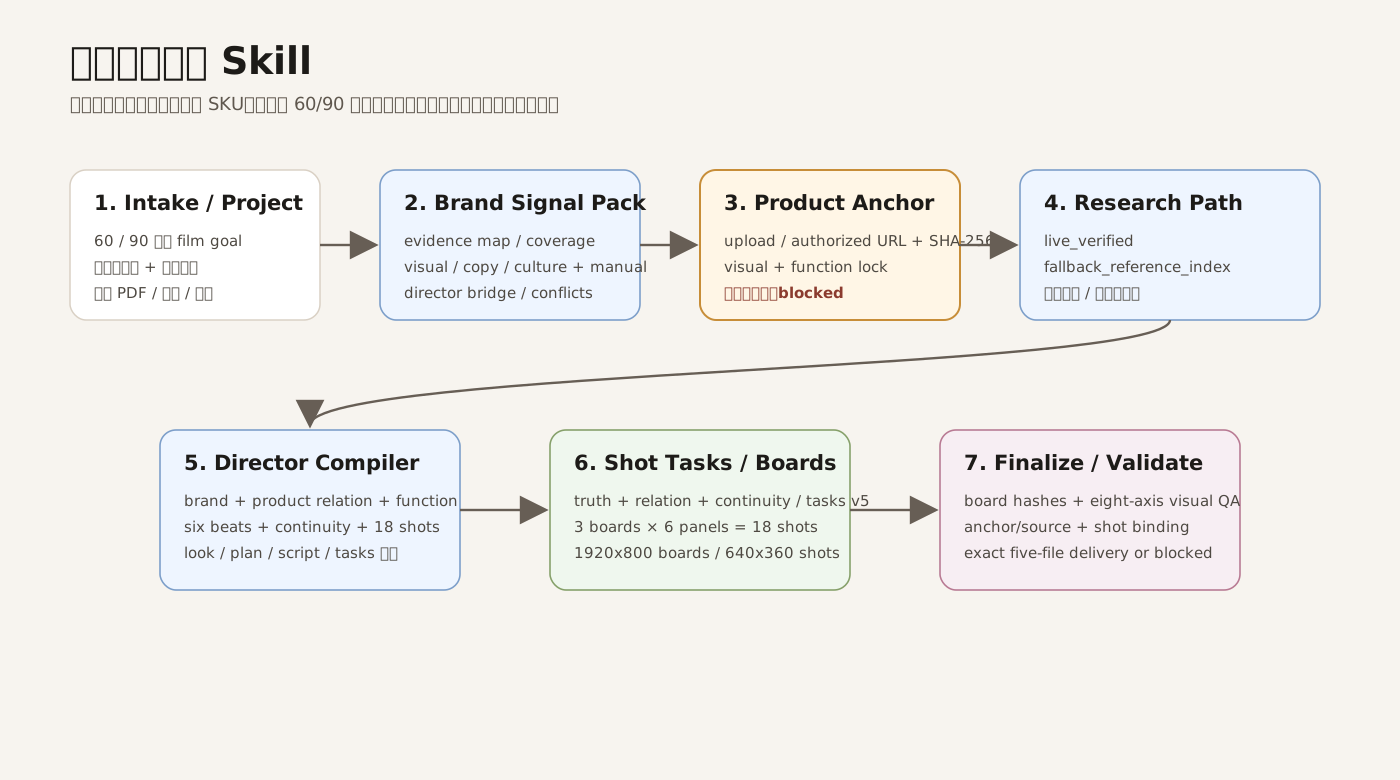
Brand sources
  -> traceable Brand Signal Pack
  -> approved Product Anchor + function lock
  -> category-neutral Product Relation Profile
  -> verified research or explicit fallback boundary
  -> six-beat Creative Story Engine
  -> 18-shot Director Matrix
  -> three storyboard boards
  -> hash-bound Visual QA
-> five-file delivery03 · FINAL FILM
CRBN public-site signals to a 21.5-second court film
This independent research case starts with the public CRBN Pickleball homepage, extracts observable brand and product signals, and translates them into one continuous on-court execution rather than a disconnected collection of premium shots.
The source record is the public CRBN Pickleball website, read on July 10, 2026. Its visible language includes “Relentless by Design,” “Elite Pop + Power,” “Floating Foam Core,” and professional player context. Those signals informed the film's pace, location, action progression, palette, and product relationship.
The video is presented as execution evidence for the Skill: public brand material becomes a traceable signal pack, direction turns the signals into connected beats, and the final media is reviewed as a film rather than accepted as isolated keyframes.
Attribution boundary: this is an independent AI workflow demonstration created from publicly available brand material. It is not commissioned, approved, or endorsed by CRBN Pickleball, and it is not presented as official CRBN advertising.
04 · FINAL FILM
Jaxon Lane Bro Mask to a 19.3-second skincare ritual
This second independent case starts with the public Jaxon Lane homepage and Bro Mask product page. It turns product-specific handling instructions into one continuous bathroom routine while preserving the same person, product, room geography, and practical light.
The source record combines the public Jaxon Lane website with the official Bro Mask product page, read on July 10, 2026. The documented use sequence is to remove both plastic films, place the mask on a cleansed dry face, leave it on for about 20 minutes, then remove it and pat the remaining serum onto the skin.
The film translates that observable relation into setup, material reveal, placement, wear, and transition beats. It demonstrates product handling and continuity; it does not test, prove, or independently validate skincare outcomes.
Attribution boundary: this is an independent AI workflow demonstration created from publicly available brand and product material. It is not commissioned, approved, or endorsed by Jaxon Lane, and it is not presented as official Jaxon Lane advertising.
05 · FINAL FILM
Jaxon Lane Rain Or Shine to a 26.8-second coastal skincare film
This case starts with the public Rain Or Shine product page and turns its daily sunscreen relationship into one continuous coastal-day sequence. The same person, product bottle, environment family, daylight direction, and natural skin finish carry from product reveal through outdoor use.
The source record combines the public Jaxon Lane website with the official Rain Or Shine product page, read on July 11, 2026. The page describes a daily moisturizing sunscreen, instructs application before sun exposure, and provides reapplication guidance.
The film translates the supported daily-use relation into product, place, preparation, outdoor movement, and skin-finish beats. It does not independently test UV protection, water resistance, ingredient performance, or visible skincare outcomes.
Attribution boundary: this is an independent AI workflow demonstration created from publicly available brand and product material. It is not commissioned, approved, or endorsed by Jaxon Lane, and it is not presented as official Jaxon Lane advertising.
06 · FINAL FILM
JM Trick destroyed denim to a 23.2-second fit-and-motion film
This fourth independent case starts with the public JM Trick homepage and the Calça jeans reta destroyed product page. It keeps one model, one garment, one exterior setting, and one daylight direction while moving from identity and wash texture to knee detail, walking drape, and full silhouette.
The source record combines the public JM Trick website with the official Calça jeans reta destroyed product page, read on July 10, 2026. The public page identifies light-blue cotton denim, a destroyed straight silhouette, and a boutique-focused B2B context while leaving the exact fiber composition subject to supplier confirmation.
The film translates those observable signals into identity, wash texture, garment detail, walking movement, drape, and silhouette. It does not claim sales performance, inventory availability, pricing, or an independently verified fiber composition.
Attribution boundary: this is an independent AI workflow demonstration created from publicly available brand and product material. It is not commissioned, approved, or endorsed by JM Trick, and it is not presented as official JM Trick advertising.
07 · PROCESS RECORD
JM Trick product page to final film workflow
This 40.77-second screen record shows the actual case sequence: exact product-page review, director instructions, three storyboard boards, text execution script, generation request, and the resulting continuous film.
This recording is process evidence for the complete case page. It is intentionally excluded from the homepage final-film showcase so process documentation and finished creative work are not presented as the same type of output.
08 · GENERALIZATION
Model the product relation, not the product name
A generic Skill cannot maintain a special branch for every product. The runtime therefore does not use a named SKU or a fixed category table to choose actions. It builds a product_relation_profile from current evidence.
| Relation field | Directing use |
|---|---|
| Observable start state | Defines the first credible product and scene state. |
| Required setup | Prevents the film from skipping a necessary action. |
| Verified action | Controls what the product may actually do on screen. |
| Interaction and support | Locks hand, body, surface, fixture, container, or environment contact. |
| Supported result | Blocks invented mechanisms, outcomes, and performance claims. |
| Observable end state | Carries product and prop state through the final shot. |
| Human-presence policy | Supports one consistent person, partial body, hands only, or no people. |
This lets the same director code handle static objects, human routines, material-led processes, movement across connected spaces, dynamic action, shared behavior, and explicit no-person scenes without importing a product-specific template.
09 · DIRECTION
Continuity without repeated framing
The Director Compiler creates six story changes across 18 shots: context, preparation, relation, function, meaning, and memory. Every shot receives a scene action, shot function, lens, camera height, angle, focus behavior, foreground layer, movement, transition, product presence, and continuity lock.
Continuity does not mean showing the same medium shot repeatedly. It means preserving identity policy, wardrobe when a person exists, product state, scene geography, light direction, required prop count, action direction, and contact physics while the information changes.
Reducing synthetic visual language
- Natural skin, fabric, surface wear, material texture, and practical exposure.
- Physically credible perspective, scale, occlusion, contact shadow, and support.
- No floating product, waxy skin, duplicated props, synthetic HDR, or stock-model pose.
- When the source says
no people, prompts reject people, body parts, wardrobe, reflections, and human shadows.
10 · INPUT / OUTPUT
A narrow public delivery, a detailed internal record
Required inputs
- One clear uploaded product image, or an exact official product-page image explicitly authorized for the current run.
- Visible product facts, behavior, function lock, forbidden mutations, locked terms, and unknowns.
- At least one brand source: PDF, public static site, product page, evidence-bearing brief, or permitted brand video.
- A 60-second or 90-second duration, film goal, target viewer, target model, and exclusions.
Exact user delivery
product_anchor.png
storyboard_part_01.png
storyboard_part_02.png
storyboard_part_03.png
model_execution_script.md
The three storyboard images each contain six visual panels. Each board is normalized to 1920x800 at a 2.4 aspect ratio. Its centered 1920x720 content region preserves six integer 640x360, 16:9 shot frames with narrow matte bands above and below.
The 60/90-second execution script is text, not another set of images. Source records, director packs, board tasks, internal shot frames, manifests, and QA reports stay inside the run directory.
Seedance-compatible image contract: every downstream image must remain between 0.4 and 2.5. The complete board is a delivery and continuity overview; each video shot uses its matching internal 640x360 keyframe rather than treating the six-panel board as one shot.
11 · PERFORMANCE
Three generation calls, incremental preparation
The board compiler makes exactly three image-generation calls instead of 18. It stores product truth, product relation, continuity, and negative constraints once, while per-shot entries use JSON references.
| Execution path | Observed preparation time | Boundary |
|---|---|---|
| First preparation | about 6.3 seconds | Excludes image-model generation. |
| Forced rerun with source cache | about 2.5 seconds | Product image download dominated this run. |
| Unchanged incremental run | about 0.32 seconds | Skips preparation when input and pipeline version match. |
The current standard mock task is about 43 KB and remains below the 50 KB task budget. Each final board prompt remains below 5,000 characters.
12 · VERIFICATION
Visual QA is a release gate
Finalization binds the three current board hashes to eight reviewed dimensions: SKU fidelity, human identity or human-presence policy, action physics, lighting and shadow, material texture, composition diversity, continuity, and AI artifacts.
The validator rejects stale schemas, modified Product Anchor facts, divergent task files, missing visual review, board-hash changes, extra delivery files, unsupported text or UI instructions, and any downstream image outside the 0.4-2.5 ratio range.
13 · BOUNDARIES
What is stable, limited, and intentionally blocked
Stable
Local PDF text extraction, public static HTML and JSON-LD, traceable evidence records, Product Anchor binding, relation-driven direction, three-board task compilation, visual QA, and package validation.
Environment-dependent
Scanned PDFs require OCR. JavaScript-only, login, or anti-bot pages require a permitted browser or manually reviewed source JSON. Brand-video speech needs a transcript or external ASR.
Intentionally blocked
Automatically promoting an arbitrary site image into the final SKU, downloading restricted public video, using public-video frames as generation references, inventing hidden product behavior, or deleting unknowns to make validation pass.
The implementation, tests, mock package and Chinese technical summary are maintained in a private repository. This public note documents the workflow, evidence and delivery boundary without exposing the protected code.
Distributed from this canonical note to LinkedIn, DEV Community, and Medium on July 10, 2026.