JIA JINGQIU / PLATFORM METHODS
Products, content
and ads by platform.
Publishing, listings, product video and advertising methods for TikTok, Amazon, Shopify, AliExpress, Mercado Libre and Shopee.
Check sellability, listing clarity, creative fit and advertising returns in that order. The tasks below include Skills, English workflows and local checks; account access and live execution require separate verification.
01 / TIKTOK SHOP
TikTok Shop.
Products sell through the shop while people discover them in content feeds. The listing, shoppable video and creator collaboration must point to the same SKU.
AIGC / VIDEO RECREATION
AIGC video recreation.
01 / DNA — Recreating viral creative elements
Break down the opening, setting, action sequence, shot rhythm and sound, then rebuild around a new script. Reuse the expressive choices while checking character, motion and product details.
Play each film; swipe to browse on mobile.
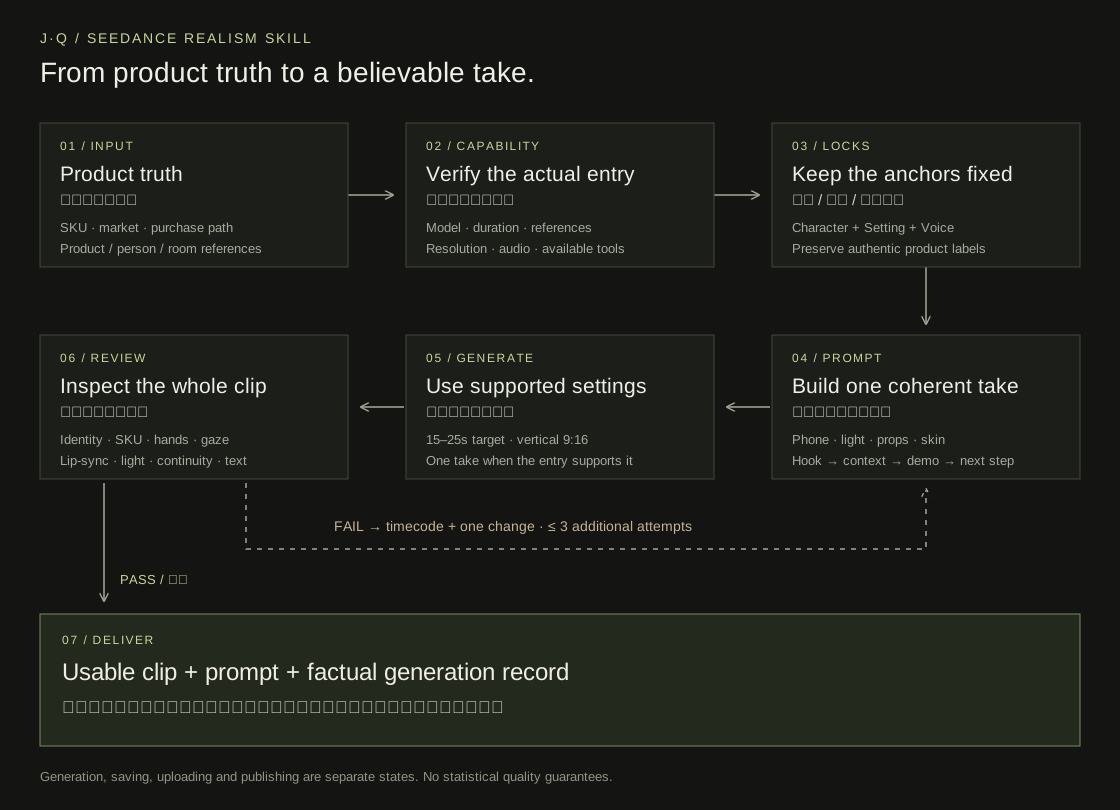
SEEDANCE / REALISTIC COMMERCE VIDEO SKILL
Seedance: believable creator-style commerce video.
Lock the person, product, room and voice. Use practical light, everyday objects, natural skin and smartphone framing to build a 15–25-second take, then repair specific defects.
OPERATOR NOTES / 2026.09
Which sample, which creative, when to spend more.
Start with what the product actually does, then choose a use case and a reason someone might hesitate to buy. Record the SKU, creator, claim, rights and test result for each version. The next brief should answer a problem found in the previous round.
01Is another sample worth sending?
Check audience fit, demonstration ability, delivery terms and advertising rights before follower count. Divide sample cost, shipping, creator fees, rights fees and production/rework costs by accepted assets with valid usage rights. If none are usable, do not report a zero cost per asset.
Track delivery, draft, revision, rights and publication per creator. A delivered sample without a draft needs follow-up; a poor demonstration needs a revised brief or a different creator. Resolve missing advertising rights before expanding sampling.
02Separate views, clicks, purchases and returns
Views without product clicks: verify the product link, then examine product visibility, use and buying reason. Clicks without purchases: check options, delivered price, shipping, stock and the promise on the page. Purchases followed by returns: inspect reasons in the original order cohort, including wrong variants, quality and fulfillment; fix the relevant claim or product.
Align account, SKU, observation window and metric definitions first. Missing joins or immature returns mean an open question, not a reason to explain all orders with total video views.
03Read GMV Max status before changing settings
Resolve ineligible products, missing rights, review issues or a paused campaign first. Creative states—In Queue, Learning, Delivering and Not Delivering—are a separate layer; the Advertising tab below assigns different actions to each.
When eligible activity has low spend, inspect exploration and ROI constraints. More videos, a lower target or Max delivery are not default fixes. Record the budget, observation window and affordable loss before any change.
04Orders are not yet a reason to scale
Reconcile receipts, refunds, product cost, commission, platform fees, shipping, ads and allocated sampling/production costs for the same products and order population, without double-counting. Hold expansion if returns are immature, costs are missing or stock cannot support it. Propose a bounded budget increase only after the agreed economics and supply checks pass.
A high creative ROI does not prove scalability, and total shop GMV is not incremental ad revenue. Keep the original settings and a review date; reduce or stop spending at the approved loss boundary.
How the Agent runs this task
Use Seller Center / Ads Manager exports, product facts and a creator ledger. Preserve account, market, SKU, video ID, version, rights scope and expiry before joining product clicks, purchases, order refunds and costs. Report missing joins; never force aggregate orders onto individual videos.
Outputs: missing rights and deliveries, status-specific checks, purchase objections by creative, a next-version brief and proposed budget changes. Samples, outreach, publication and spending changes require separate approval, authorized execution and readback.
review.py provides generic offline data and economics checks. It does not automatically recognize TikTok exports, diagnose GMV Max states or operate an account. The decisions above require real exports, field mapping and human review.
DEMO / More clicks, but no budget increase
Synthetic observations for one example SKU in the same window. These are not personal campaign results or a randomized experiment.
| Version | Views | Product clicks | Purchases | Click-to-purchase |
|---|---|---|---|---|
| A / Function demo | 10,000 | 200 | 10 | 5% |
| B / Use-case opening | 10,000 | 400 | 10 | 2.5% |
Decision: B has more product clicks but no additional purchases, so this alone does not support scaling. Check its product link, variants and delivered price. If buyer questions point to compatibility, retain the opening and add a compatibility demonstration in the next version, holding other conditions as steady as possible. Follow refunds in the original order cohort. Do not declare a winner with insufficient observations or immature returns; this table does not establish incrementality.
Use the ad features available to the current US account. Content volume, budgets and follow-up frequency depend on the product and the team's capacity.
Make sure every linked variant can actually be bought.
- INPUT
- Product and variant IDs, price, available stock, shipping, review results and linked videos.
- METHOD
- Draft in the correct category, then verify every variant before submission. A seller pause targets only the selected SKU. For platform removal, resolve the stated cause rather than repeatedly recreating the listing. Recheck stock and delivery before restoring it.
- VERIFY
- Reopen the buyer listing and video product link. Check options, delivered price and availability. If approval has not produced a buyable listing, fix the product before sending more creator or paid traffic.
Answer “will this work for me?”
- INPUT
- Product facts, real photos, specifications and limits, plus recurring buying questions from reviews, Q&A and support.
- METHOD
- Build titles, attributes and descriptions around use, compatibility and option differences. Size questions need dimension evidence; usage questions need instructions. Keep a revision record instead of inventing extra benefits.
- VERIFY
- Images, video and copy must match the same SKU and promise. Do not present placeholders or digital renders as real-item listing photos. Correct exaggerated effects, missing limitations and wrong specifications before testing conversion.
Give the next version one buying question to answer.
- INPUT
- Real-product references, use case, purchase objection, prior results, linked SKU and advertising rights.
- METHOD
- Brief from product fact → scene → objection → demonstration evidence. Separate opening, demonstration and buying prompt, then number each version. Prefer one testable change per round; record fixed conditions, metrics and budget limits. Feed the result into the next brief.
- VERIFY
- Preserve motion, dimensions and product details; generated footage is not a physical test. Check rights scope, expiry, SKU and stock before publishing, then reopen the actual link. Views do not replace purchase and return checks.
Read creative status, then check the economics.
- INPUT
- Product and creative eligibility, rights, campaign and creative states, spend, clicks, purchases, and matched refunds and costs.
- METHOD
- Resolve rights, review and pause issues before using the table below. Low Target ROI spend calls for checking constraints and available assets. A Max delivery proposal needs its own short-term budget and loss limit, approved before switching; it is not an ROI-protection mode.
- VERIFY
- GMV Max reports include organic, paid and affiliate-related orders for promoted products, not just incremental ad sales. Reconcile profit and returns separately. Its automatic allocation of exposure is not a randomized creative comparison.
| Creative state | Interpretation | Next action |
|---|---|---|
| In Queue | Not yet explored; not evidence of failure. | Check availability, rights, total spend and queue age. Propose a capped test if acceleration is needed; do not duplicate-upload in bulk. |
| Learning | Still being tested; no winner yet. | Observe clicks, purchases and cost within the planned window. Avoid restarting over short-term zero orders, while still respecting the loss boundary. |
| Delivering | Receiving spend is not proof of profit. | Reconcile refunds and costs, then identify reusable demonstrations and buying reasons. Propose more budget only after economics and stock checks. |
| Not Delivering | Explored without sustained spend; not the same as rejection. | Compare use case, evidence and purchase objections with delivering versions. Retest with a specific new hypothesis, not repeated toggling. |
TikTok Shop rules here follow US documentation; confirm other markets and account eligibility separately.
02 / AMAZON
Amazon.
SellerSprite, Sif, Sorftime and Xiyou identify opportunities. Your orders, costs and inventory decide what to select, change and spend.
RESEARCH → PRODUCT → OFFER → CONTENT → ADS → REVIEW
External data proposes a test. Business results decide the action.
Compare products serving the same use, price range, specifications and marketplace before judging demand, competition and cost. Selection, offers, content and ads share one set of product facts. Exposure estimates, actual orders and contribution are different measures.
Four sources, four distinct questions.
Keep original exports and field definitions. Map marketplace, time window, parent/child ASIN, seller SKU, category sample and unit before comparing. A vendor offering an API does not mean it is connected here; modules, subscriptions, permissions and coverage still need checking.
| Source | Decision it informs | Boundary |
|---|---|---|
| SellerSprite / 卖家精灵 | Investigate a need through relevant queries and comparable products, then narrow by size, price and actual variant. | Sales estimates are not settled orders. Children sharing a parent BSR may repeat the same parent-level estimate: do not add them. Keep calendar-month search volume, rolling windows, storefront observations and forecasts distinct. |
| Sif | Inspect the queries, visible ad formats and exposure positions where competition concentrates. Separate one ASIN, a whole listing and multiple variants. | Traffic share describes exposure, not clicks, orders or actual budget. A term not observed in the selected window is not proof it was never targeted; missing values are not zero orders. |
| Sorftime | Place a product within category seasonality, pricing, new-versus-established products and leading competitors to assess timing and entry space. | Estimated sales are not your ledger. Read each module's sample, window, marketplace and parent/child definition; one feature's coverage cannot be applied to every module. |
| Xiyou Insights / 西柚洞察 formerly 西柚找词 | Inspect specific variants, query positions and change dates to locate where exposure is shifting. | Its own category taxonomy is not an Amazon browse node; exposure scores are not orders. Observed variants are not all active variants. Device, postcode and update frequency affect the sample. |
When the four sources disagree
Match marketplace, window, parent/child ASIN set and metric meaning first; then inspect device, postcode and capture scope. Do not compare seven rolling days with a calendar month, parent estimates with child orders, or average exposure scores into sales. Retain original values, definitions and conflicts; hold unverified merges. Two vendors using the same storefront or ABA information are not two independent transaction records.
Return to your ad reports, orders, refunds, product costs and inventory for the decision. External evidence proposes a test; actual outcomes decide continuation. An Agent can organize authorized exports, flag scope conflicts and draft tasks—not replace missing values with zero or purchase extra data automatically.
DEMO: the parent grows, but the target child declines
First check whether the two changes describe the same measure and window. If visible parent traffic rises while the target child's exposure falls, see whether another variant took the additional exposure. Use your own orders to check whether the target child's sales also fell; inspect price, Featured Offer (Buy Box), delivery, availability and stock.
If that child is out of stock, restore availability or revise replenishment instead of increasing budget from the parent trend. If it is sellable and entry points shifted, propose a specific use-case query test for that child. A parent estimate cannot be split into exact child orders. This is a decision example, not the user's trading history.
Prove it can work before deciding how much to buy.
| Stage | Decision condition | Action and output |
|---|---|---|
| Comparison pool | Matching use, price range, specifications and market, with consistent parent/child scope. | Keep a reviewable ASIN set; broad category volume is not the target need. |
| Demand and entry space | Is growth seasonal, promotion-driven or sustained? How concentrated are leaders, and are new products entering? | Use Sorftime for structure, SellerSprite for needs and Sif/Xiyou for entry points and variants. Do not chase a season the supply chain cannot reach. |
| A fixable pain point | Does the concern recur in reviews, and can the actual product or explanation improve it? | Turn it into a specification or sample-acceptance requirement with physical evidence. Reviews are not proof of efficacy. |
| Cost and cash | Net receipts, non-ad variable costs, MOQ, inbound freight, lead time, returns risk and cash tied up. | Calculate contribution under conservative conversion assumptions and limit trial exposure. Missing cost is a task, not something an external sales estimate can offset. |
| Limited trial or reject | Product, cash and fulfillment must be feasible before a bounded test. | Specify SKU, units/budget, review date and stopping conditions. Revise or stop when actual price, conversion, returns or contribution fail the plan; do not automatically order a large replenishment. |
DEMO: a competitor's conversion rate cannot underwrite a new ASIN
A stress test only: one unit per order, $30 net receipts and $21 non-ad variable cost. External CVR and CPC do not establish this new ASIN's ability to convert.
| Assumption | Implied CPA | Contribution after ads per unit |
|---|---|---|
| Borrow external CVR 15% and CPC $0.90 | $0.90 ÷ 15% = $6 | $30 − $21 − $6 = $3 |
| New-ASIN stress case: CVR 5%, CPC still assumed $0.90 | $0.90 ÷ 5% = $18 | $30 − $21 − $18 = −$9 |
Both rows are assumptions, not forecasts. Reduce uncertainty through sample and listing checks, a bounded trial and actual acquisition costs—not inventory bought against an unearned $3 profit. If the conservative case exceeds the acceptable loss, reject it or redesign the cost plan.
Identify the object before fixing availability.
- INPUT
- Marketplace, seller SKU, ASIN, parent/child relation, category fields, current offer, inventory, delivery and issues; retain original values and timestamps.
- DECISION
- Match an existing ASIN or genuinely create a new product? Is this a closed offer, missing stock, a field issue or incorrect product data? Do not create a duplicate to bypass the underlying problem.
- ACTION
- Propose the smallest change to the exact marketplace and SKU. Temporary offer closure and deletion are separate; operating on your offer is not deleting the shared catalog.
- RECHECK
- Read receipts and issues, then check the actual offer, stock, delivery, storefront variant and buying state. Accepted does not mean searchable or buyable. Inspect an uncertain submission before retrying.
Three tasks that “relist it” does not distinguish
Out of stock: check replenishment and expected availability, with ads following sellability. Field errors: repair the specified field against current category requirements and product facts, then read back the issue. Planned closure: define seller SKU, scope and reopening conditions; deletion requires its own explicit confirmation. Deliver old value, proposed value, reason, owner and resulting state.
A query describes a need. The listing must provide evidence.
| Query intent | Facts to verify | Content location |
|---|---|---|
| Product type / primary use | What the item actually is and who it serves, matching the real SKU. | Title and category attributes under current rules; no unrelated high-volume terms. |
| Size / compatibility / material | Real measurements, fitting conditions, exclusions and variant differences. | Accurate attributes, bullets and size/compatibility images; critical conditions also need readable text. |
| Use and purchase questions | What reviews reveal about uncertainty, and whether physical or test evidence supports an answer. | Bullets, description, eligible A+ content or video—not review language converted into unsupported claims. |
For the same query, where is the loss: impressions, clicks or purchases?
Where eligible, use your Search Query Performance (SQP) data under a fixed marketplace, window, query and brand/ASIN scope. Start with demand, then impression share, click share and purchase share. These shares have different stage denominators; their subtraction is not a count of lost buyers. SQP purchases are not automatically ad-attributed orders.
Low exposure: inspect relevance and entry points. Exposure but weak clicks: check the main image, price and search-result presentation. Clicks but weak purchases: rule out Featured Offer, price, delivery, stock and variant selection before diagnosing an unanswered buying question.
DEMO change: the buyer asks, “Will it fit in my shelf space?” Verify external width, depth, height and opening clearance. Change one dimension image and its corresponding explanation, not title, price and ads at the same time. Preserve the prior version and review window. Use a randomized Manage Your Experiments test when eligible and the content type is supported; a before/after comparison alone is an observation, not proven conversion lift.
One buying question, one verifiable demonstration.
| Location | Job | Production and acceptance |
|---|---|---|
| Main image / image set | The main image is a static product presentation; supporting images explain size, included parts and differences. | Follow current category rules without fabricated badges. Match measurements and accessories to the physical item; rendering cannot create specifications. |
| PDP product video | Provide pre-purchase evidence for installation, use, scale and limitations. | Real measurement and continuous installation → necessary detail → complete result. Check product consistency, captions, rights and current upload eligibility; verify actual display after submission. |
| Sponsored Brands video | Communicate a relevant benefit quickly within an eligible ad format and placement. | Make a separate opening, demonstration, text-safe-area and destination version. Do not simply reuse the full tutorial; confirm current account eligibility, specifications and destination. |
DEMO shot brief and local repair
Question: “Can it still open after I place it inside?” Shot 1 verifies real shape and scale; shot 2 continuously shows placement and opening, including required clearance; shot 3 identifies verified fitting conditions and exclusions. Without the real item or approved evidence, assign measurement/filming work. Generated footage cannot prove size, load capacity or compatibility.
If geometry, accessories or movement are wrong, repair the affected shot and recheck facts and continuity. The Agent organizes product truth, buyer questions and storyboard candidates; physical evidence and media-rights review still need completion.
Name the object to change, not just “optimize the ads.”
Confirm sellability and reporting windows, then separate search queries, targets, match types, ad groups, campaigns and placements. They are not interchangeable reporting objects.
| Observation | Decision | Next task |
|---|---|---|
| A specific query is irrelevant | For example, you sell only the complete item but match an explicit replacement-part request. Verify the actual query and triggering target. | Propose a negative-exact candidate for that query, checking its scope and possible false exclusions. Do not block all relevant queries sharing the root term. |
| A relevant query has expensive orders | Inspect bids, placement, price/delivery, unanswered page questions and mature conversion separately. Spend alone does not establish irrelevance. | Review target/bid, supported placement evidence or a destination change. Preserve relevant demand; output prior/proposed values, reasons and recheck conditions—not a blanket keyword exclusion. |
| A campaign placement is expensive | A campaign × placement report supports that grain. A campaign may contain many queries and targets. | Review at campaign/placement level. Do not join it into invented query × placement rows or claim a query's spend at a particular placement from that report. |
| A budget increase is proposed | Check contribution, window maturity and stock. A competitor's exposure is not its actual budget or a reproducible cost for your store. | Propose a bounded adjustment only when business targets and replenishment support it—not because external traffic grew. |
Give SP, SB and Display different jobs
SP tests purchase needs through specific products, keywords or product targets. Eligible SB formats support brand/collection and video communication. Display tasks follow the product, audience or return-visit capabilities actually available in the account. Read each format's attribution window, metric definition and objective separately rather than forcing one conversion rate across them.
Retain each report's real marketplace, profile, campaign/ad group, target, match type, query, placement and date fields at their actual grain. Missing joins limit the claim. ACOS/ROAS use matched ad-attribution definitions; TACOS uses ad spend and total sales within the same scope. TACOS is not proof of incremental sales.
DEMO: why 25% ACOS still does not justify scaling
Synthetic example: one SKU, one unit per attributed order, matching marketplace/currency and mature window, no cross-product halo or refunds, and the ACOS sales denominator equals $300 net receipts. Verify these conditions in a real account; ad sales and net receipts cannot otherwise be substituted.
| Condition / calculation | Result | Meaning |
|---|---|---|
| $30 net receipts − $21 non-ad variable cost per unit | Break-even CPA $9; break-even ACOS 30% | Break-even covers the included variable costs, not necessarily the whole company. |
| Retain $3 contribution per unit | Target CPA $6; target ACOS 20% | Available ad cost is $30 − $21 − $3. |
| 100 clicks / 10 orders / $75 spend | CVR 10%; CPC $0.75; CPA $7.50; ACOS 25% | Orders do not guarantee the contribution target. |
| $300 − $210 − $75 | $15 contribution after ads versus a $30 target | Investigate cost or purchase friction before scaling. |
| Assume CVR remains 10% | $6 × 10% = CPC $0.60 | A conditional cost reference—not an instruction to bid $0.60. Bids differ from realized CPC, and conversion can change. |
Inventory also blocks an unexamined increase: 90 units ÷ current sales of 3/day = 30 days, versus 45 days to replenish. Without confirmed inbound supply, even the current pace may create a gap. Verify replenishment and mature order costs before reducing spend, repairing the destination or arranging a bounded test. All figures are demonstrations, not the user's results.
Agent deliverables and what is actually implemented
Deliver source/scope mappings, a competitor pool and conflict log, trial/rejection reasons, exact-SKU change proposals, listing/shot briefs, and ad-adjustment candidates with retest conditions. Identify the object, prior/proposed values, evidence and owner. Access changes, negatives, bids, budgets and deletions execute only within the confirmed scope, followed by readback.
This public repository's paid / catalog modes are offline contribution and exact-SKU proposal checks over prepared inputs. They do not connect the four vendors, join ad-report detail automatically, understand video frames, publish listings or change your ads. Real account operations still require available authorized tools; the historical suite's scope remains as documented at its original link.
Confirm current marketplace, category and account rules, reports, content and ad eligibility. Demonstrations explain decisions, not actual results or universal advertising thresholds.
Data definitions and operating references
SellerSprite fields ↗ Sif ↗ Sorftime ↗ Xiyou Insights ↗ Listings lifecycle ↗ Product listings ↗ Product video ↗ Sponsored Products ↗
03 / SHOPIFY
Shopify.
The storefront is yours to design. Product status, channel publication and the customer's buying experience need separate checks.
OPERATOR NOTES / 2026.09
Design for the remaining buying question.
Identify the information still missing from the buying decision before choosing page length and order. Use scenes, evidence and demonstrations for new visitors; make variants, price, delivery and checkout easy for ready buyers.
01Before building
Start with brand, product and goal. Resolve positioning, alternatives, best-fit buyers and purchase path before layouts, media, interactions and data.
02A new visitor needs explanation
Use context, evidence and demonstrations. Returning or already-convinced buyers should not be forced through a long story.
03Looks fine, feels difficult on mobile
Select variants, add to cart and open the cart. Check chat, promotion and loyalty overlays—not just screenshots.
04Traffic rises without contribution
Review source, device, page version, events and orders. Separate comprehension, selection, checkout and audience problems.
How the Agent runs this task
Check product CSV, inventory and variant mapping separately; propose exact changes before authorized editing and readback.
Local checks: exact-SKU change proposals and matched-population contribution. Account access still uses separately authorized tools.
DTC design, catalog operations, media and paid-traffic destinations belong to the same Shopify purchase path.
Check status and channel publication separately.
- INPUT
- Products, variants, prices, stock, shipping, channels and markets.
- METHOD
- Review a draft before confirming status and channel availability. Test the customer journey after publishing. Treat stopping sales, archiving and permanent deletion as separate actions.
- VERIFY
- Visibility and purchasing in the target market; correct variants, prices, stock and delivery; expected availability after archiving.
Design DTC product pages around buying decisions.
- INPUT
- Positioning, customers, product evidence, competitors and return promises.
- METHOD
- Map buying questions before arranging information, options, evidence and the purchase action. Review the Skill-generated first build for content, interactions, product data and search metadata.
- VERIFY
- Correct product data behind options, price and stock; usable mobile, error-recovery and purchase flows.
Help shoppers understand products and options.
- INPUT
- Real-item and variant references, brand direction, scenes, posters and rights.
- METHOD
- Produce use, detail and instruction footage for the page, then add it to product media. Do not alter color, material, construction or specifications.
- VERIFY
- Agreement with the current variant; mobile loading, playback and mute behavior; no obstruction of buying controls.
Separate the store destination from acquisition channels.
- INPUT
- Catalog, website events, account permissions, orders, refunds and costs.
- METHOD
- Connect approved Google, Meta, TikTok or other channels separately. Match ads, catalogs and pages, retain claim and page versions, then reconcile spend and orders.
- VERIFY
- Current catalog data, working links and events, no duplicate orders, and returns calculated after refunds and relevant costs.
Official references
Products: status, publishing and archiving ↗ Product media ↗ Sales channels ↗
04 / ALIEXPRESS
AE / AliExpress.
The same product has different selling conditions and margins across countries, variants and delivery options. I use those differences to choose products, revise pages and plan promotion—not a store-wide average to decide the fate of every SKU.
MARKET / OFFER / CONTRIBUTION
Do the extra orders
actually earn more?
Start with who controls what: pricing, discounts, fulfillment, page edits and promotion settings. Self-operated or managed selling is more than a label. If you can only submit a supply price, decisions must use your actual settlement—not the retail price the buyer pays as your revenue.
01Choose the country, then a viable offer
Compare competing offers with the same specifications, pack size and delivery conditions. Record product price, shipping, eligible discounts, checkout taxes and estimated arrival. The buyer's total determines competitiveness; the seller's net settlement and costs determine viability. Comparing only the lowest displayed price can mix an accessory with the main product.
Then break down your own offers by country × actual SKU × fulfillment method. If demand exists but shipping consumes the margin, first test packaging or fulfillment options. A combination that only sells at a loss does not deserve more promotion simply because it attracts traffic.
02Diagnose impressions, clicks and payments separately
Low impressions: check sale eligibility, category attributes, demand terms and delivery coverage before blaming the selling point. Impressions without clicks: compare search intent, the lead image, the actual variant price and competing offers within the same country and traffic source. Clicks without purchases: check available variants, total price, arrival, specifications and trust information. Cancellations or refunds after payment: separate stock, fulfillment, quality and description issues.
Change one main issue at a time, recording the old value, new value, target metric and observation period. Conversion and refund analysis must allow the relevant order cohort to mature. If search-term or funnel fields are missing, obtain the data rather than inferring the cause from a GMV total.
03A promotion is more than discounted order volume
Identify who pays for seller coupons, platform subsidies, transaction fees, advertising and fulfillment. Do not deduct fees already withheld from settlement twice. Do not count an unconfirmed subsidy as seller revenue.
Calculate contribution per order for each variant, then check whether the sales mix shifts toward loss-making variants. If orders rise but contribution falls, first adjust participating variants, the offer or the seller-funded portion instead of increasing the budget. Count fixed costs such as event entry fees separately.
04Positive contribution still needs stock and cash
Planned order growth must be supported by available stock, replenishment lead time, fulfillment capacity and working capital. Narrow promotion where stock is missing. For slow-moving stock, compare the cost of tying up capital with the loss from clearance. Pause sales at the relevant country and variant level, retaining open orders, after-sales records and reasons; repeatedly deleting listings does not solve the problem.
Separate the buyer's price from the seller's revenue
Buyer total = product price + buyer-paid shipping − eligible buyer discounts + applicable buyer-paid taxes not already included. Retain country, address conditions, variant and observation time; do not compare offers with different tax treatment as if they were equivalent.
Contribution per order = reconciled seller settlement income − product, fulfillment, after-sales losses and variable promotion costs not already deducted. When starting from net settlement, identify whether commissions, coupons and refunds have already been withheld. Keep managed-supply settlements separate from self-operated retail orders. Deduct fixed promotion costs separately from total contribution.
Demo arithmetic: variant A settles at 18 with 12 of costs not yet deducted, contributing 6 per order; during promotion it settles at 16 with the same 12 of costs, contributing 4. Variant B normally contributes 10 − 8 = 2; during promotion, 7.5 − 8 = −0.5. These assumptions drive the example below. They are neither current platform fee rates nor results from my store.
TRY THE NUMBERS / DEMO
Change the numbers.
Is the promotion worth running?
In the initial demo, orders rise from 100 to 150 while contribution falls from 480 to 200. Both plans cover 7 days in the same market, with all amounts in USD. Change the order counts and contribution per order to see the effect. Every value is a demo assumption. Contribution per order is after variable costs but before the fixed costs below.
| Actual variant | Baseline orders | Baseline contribution per order | Promotion orders | Promotion contribution per order |
|---|---|---|---|---|
| A / Main variant | ||||
| B / Lower-priced variant |
Baseline: 100 orders / contribution $480.00; promotion: 150 orders / contribution $200.00.
Promotion contribution falls by $280.00. Each additional B order loses $0.50. Review its offer and promotion cost allocation before increasing the budget simply because orders grew.
With the promotion sales mix, contribution per order and fixed costs unchanged, approximately 325 orders would match baseline total contribution. This is not a volume forecast; whole-unit variant quantities, replenishment and cost tiers need a fresh calculation.
Calculated locally; inputs are not uploaded. Baseline and promotion are comparison scenarios, not measured incremental lift. Corporate fixed overhead is also excluded.
What the Agent delivers—and what already runs
Provide product and variant tables, performance by country, orders and settlements, discount funding, logistics costs and currently editable fields. Match country, SKU, order cohort and fees to deliver three tables: comparable offers, contribution by SKU, and prioritized actions. Each action names its exact target, evidence, proposed field change, owner and review metric.
The model organizes search intent, review questions and copy or visual drafts; code handles the arithmetic. promotion_mix implements the variant mix, total contribution and matching-order calculation above; paid checks contribution on a consistent basis, and catalog generates exact-SKU changes. Settlement normalization, live bidding and automatic uploads are not implemented by this code. Real writes still use existing, authorized tools.
Choose viable combinations. Diagnose before pausing.
- SELECT
- Compare demand, equivalent total prices, contribution and supply by country, main variant, pack and delivery option. Test viable combinations for a new product rather than launching every variant at once.
- ACT
- Fix fields behind eligibility or attribute errors; pause the affected variant or promotion for stockouts. For persistently low contribution, reconcile settlement, the offer and promotion funding before choosing to restore sales, revise pricing or clear stock. If the account lacks control, prepare a request rather than assuming a direct edit is possible.
- RECHECK
- Record the exact SKU, old and new values, eligible destinations and delivery promise. Verify that purchasing, fulfillment and contribution recover—not merely that a bulk submission succeeds.
Search terms should explain the buyer's choices, not fill space.
- MAP INTENT
- Separate local category, use-case and specification or compatibility terms. Exclude irrelevant popular terms using actual product attributes. Compare competitors in the same country with the same use and pack size. Reviews reveal questions; they are not direct evidence of product performance.
- BUILD THE PAGE
- The title identifies the product and key specification; the lead image shows what is sold and included; attributes support filtering. Variant names, size diagrams and packing lists reduce the risk of a wrong purchase. Verify units and wording by country, fixing inaccurate promises before polishing copy.
- RETEST THE ISSUE
- For search terms and lead images, examine impressions and clicks from the same source. For specifications, arrival and buying guidance, examine payments after clicks and description-related refunds. Change major variables separately, with observation periods and evidence requirements based on traffic and order cycles.
Choose the buying question before the shot.
- DEFINE THE TASK
- For compatibility: connector close-up → connection process → verified fit. For size: ruler or reference object → actual use → included items. Use only verified specifications for this SKU; generated imagery cannot prove performance.
- PRODUCE
- The product-page version explains how to choose and use it. The promotion version establishes the situation and difference, then leads to the same variant. Record the product reference, shot purpose, local subtitles and version. If a model changes the connector, quantity or material, repair only the affected shot.
- RECHECK
- Link product and asset versions, then observe product visits, payments and relevant after-sales reasons. Without asset-level order data, use a documented replacement test rather than claiming incremental orders caused by the video.
Choose profitable products before the charging model.
- SELECT THE TEST
- Choose country × SKU combinations with supply, a competitive equivalent offer and resolved page questions. Separate CPC, transaction-based fees and platform promotions using the current account's available tools. Record budgets, seller-funded costs and exit conditions independently.
- DECIDE WHAT TO CHANGE
- If irrelevant terms drive clicks, narrow relevance. If relevant clicks do not buy, first fix the offer and page. Where organic orders already occur and budget is constrained, assess contribution, stock and cash recovery before expanding. Review variant demand and promotion discounts together.
- LIMITS & RETESTING
- For CPC advertising, contribution per order before ads × an expected purchase rate on the same basis can estimate break-even CPC. It is not a recommended bid, and the conversion rate needs a mature sample. Do not apply this bidding formula without control over click bids. After execution, reconcile actual charges and order contribution; platform GMV is not incremental profit.
Category, region and arrangements such as self-operated or partially managed fulfillment affect fields and fees. Use the current seller account and applicable agreements.
Official references
Product schema ↗ Merchant agreement ↗ Marketing terms and fees ↗
05 / MERCADO LIBRE
Mercado Libre.
Choose the market, product and fulfillment route before catalog competition, advertising and replenishment. Low exposure does not always mean a budget shortage; fast sales do not always justify another shipment.
MARKET / CATALOG / STOCK / ADS
Find the constraint.
Then change the offer, ads or stock.
I review product competitiveness alongside operating costs: which country to sell in, the delivery promise, the reason an offer loses in the catalog, and the products affected by an ad change. Each action must explain the problem it addresses and the contribution an additional order could leave.
01Choose a viable market and route
Compare demand for equivalent specifications, buyer total, arrival time, eligibility and after-sales costs by country × actual SKU × route. Use measured package dimensions and weight. A bestseller list provides candidates, not evidence that the same offer works in another market.
For Mexico, first confirm account access to cross-border direct shipping or Full, then compare contribution and cash recovery. For Brazil, reassess local wording, eligibility and available routes instead of copying the Mexico plan. Flex needs local coverage, a carrier and an actual quote; platform support is not a substitute for the seller's delivery cost. A route in the official calculator does not establish account access.
02A catalog loss is not always a price problem
Confirm catalog_listing and the exact catalog match, then distinguish winning, sharing_first_place, competing and listed. Read available reason, boosts and price_to_win to separate price, delivery and reputation constraints. Listed is not delisted; these competition states do not apply to non-catalog items.
Only test a candidate price against costs when price is a relevant, editable factor. Seller income minus product, fulfillment, after-sales and advertising costs not already withheld must meet the chosen contribution floor. Never deduct a fee twice. If the candidate falls below the floor, review costs or fulfillment instead of continually selling at a loss to win the catalog. Record buyer-location conditions when rechecking, since the winner can vary by location.
03Budget shortage or ad-rank loss?
Read budget and ad-rank impression losses for the same campaign and date window. Budget-limited campaigns only qualify for a capped increase when mature order contribution and stock support it. When ranking is the main constraint, first review offer strength, conversion and the trade-off in current targets. Looser targets tolerate more cost; they do not guarantee profit. Missing fields are not zero, and both constraints can coexist.
Read the account's current strategy and editable target first. Some interfaces use ROAS, others ACOS; do not universally prescribe a higher ACOS. Raising target ROAS tightens the required return; raising target ACOS tolerates a larger advertising share of sales. These move in different directions. Review the active strategy, actual spend and contribution after a change; neither target promises profit.
Before acting, map site → advertiser → campaign → ad_group → included products. Current Ad Groups use CATALOG / FAMILY / ITEM types. Verify actual relationship keys and members; a variation is not necessarily independently movable or pausable. Separating a new-product test is a proposed action, not something a product spreadsheet alone can execute.
04Replenish Full—or release slow stock?
Estimate demand using valid daily sales, replenishment and receiving-to-sellable lead time, the review interval and safety stock. Subtract sellable stock and confirmed inbound units that can arrive in time. Treat promotion peaks and stockout days separately. Unreceived or unavailable units cannot support today's orders; cash, warehouse capacity and actual appointments also constrain the plan.
For fast sellers, compare post-replenishment contribution and cash turnover. For slow stock, compare the future cash outcome of holding, discounting and removal, including future storage, aging and removal charges. Sunk costs should not decide the next step. Confirm Full charges by country, size, stock age and account rather than imposing a region-wide fee or age threshold.
DEMO / Three low-exposure products, three different decisions
These are fictional Mexico scenarios in MXN, not my store results or current platform fee rates. Exposure uses the same 7-day window, with a different campaign for each product. Loss percentages belong to those campaigns, not allocated SKU metrics. Contribution is assessed separately using mature orders.
| Product and evidence | Next action | Scope and review |
|---|---|---|
| A / Desk lamp Catalog listed; reason indicates a reputation constraint; loss reports unavailable. | Investigate and assign the relevant fulfillment or after-sales correction. Do not infer a budget shortage from low exposure or cut the price automatically. | Address the store-level cause and this item's competition eligibility; identify other affected products. Recheck the reason, catalog state, buyability and delivery for the target address. |
| B / Storage box Campaign B loses 45% to budget and 5% to rank. Mature contribution is +70 per order. Sellable stock covers 21 days; replenishment is expected in 10. | If all current ad groups also pass contribution and stock checks, propose a capped campaign B budget test. Set its ceiling from affordable extra spend and supply—not an assumption that future orders will each contribute +70. | A campaign budget affects all its ad groups; list members first. Review loss shares, spend, mature contribution and stock coverage, not just recovered impressions. |
| C / Mount Campaign C loses 5% to budget and 55% to rank; catalog competing. Candidate selling price: 850. Assumed total costs before ads at that price: 880, including this example's seller-paid transaction and fulfillment charges. | The candidate loses 30 before ads, so reject price matching. Compare delivery, specification clarity and viable costs first. Low rank is not a reason to raise the budget and loosen targets together. | Prepare an item-level offer or page proposal first. List every member before a FAMILY-group change. Review orders after relevant clicks, return reasons and contribution; reconsider ads after meeting the floor. |
One change informs the next decision; it does not establish causation. Reconcile currency, market and order populations before comparing revenue and costs. If returns are not mature, defer profitability and scaling conclusions.
What the Agent delivers—and what the code actually does
Provide market and route, product/catalog states, ad groups and members, matched-window reports, order settlements, stock age and replenishment plans. Deliver country × SKU route comparisons, catalog causes and candidate offers, campaign/ad-group impact maps, and replenishment or clearance proposals. Each names the object, evidence, proposed field, cost impact, owner and review date.
The implemented mercado_ads check runs locally. It checks supplied site/advertiser/campaign identities, AdGroup types and member relationships, retaining all affected campaign items. Campaign-level budget/rank losses lead to data requests, catalog-cause or ranking reviews, a hold, or a capped-spend review. The user chooses materiality and extra-spend limits; these are not platform recommendations. Missing metrics stay unknown, and campaign percentages are not allocated to SKUs.
review.py only accepts prepared JSON. Complete membership, sufficient stock, complete costs and acceptable contribution remain checks supplied by the caller after verification; the program neither reads the account nor independently proves those claims. paid separately reviews matched-population contribution, and catalog proposes exact-SKU differences. Raw settlement normalization, Full replenishment calculations and ROAS/ACOS target optimization are not included. Real price and ad changes still require authorized tools, exact targets and confirmation, followed by readback. Pausing an ad is separate from deleting a listing.
Run the synthetic example: python3 scripts/review.py examples.json --example mercado_ads. It is separate from the three operating scenarios above and does not represent a real account read.
Adapt the method to the market, account and product. There is no fixed group size, universal ROAS/ACOS target or automatic scaling guarantee. Reconcile attributed sales, total channel sales and operating contribution separately.
Publish viable combinations. Pause for an identified reason.
- SELECT & PUBLISH
- Propose a listing only when market, actual variant, catalog match, route and contribution work together. Keep the shared catalog product separate from the seller's offer. Do not change catalog association to borrow unrelated reviews or specifications.
- DIAGNOSE A PAUSE
- For stockouts, address affected availability and promotion. For seller-paused items, check the original reason. For moderation, correct status/substatus issues. Catalog listed calls for a competition review, not delisting treatment. Compare clearance and future holding costs before exiting slow sellers.
- RECHECK
- Verify the exact item/variation, buyability, catalog match and delivery to the intended region. Record data submission, moderation approval and recovered sellable stock separately. Retain open orders and after-sales records instead of repeatedly deleting links.
Help the buyer identify the right product.
- FIND THE QUESTION
- Use local search wording, questions and return reasons to separate discovery, understanding, wrong purchases and arrival concerns. Lock the real product, category, required attributes and exact model first. Review Brazilian Portuguese and Mexican Spanish independently, not just the translated title.
- MOUNT PAGE EXAMPLE
- The title identifies the use and verified fit. Images explain the mounting interface/range, installation conditions, dimensions and included parts. Only state evidenced load or compatibility claims. Correct inaccurate shared catalog information through its proper process rather than showing conflicting specifications in seller images.
- RETEST THE ISSUE
- Relevant impressions without clicks: test the lead image and offer clarity. Clicks without orders: inspect variants, buyer total and arrival. Compatibility-related returns: prioritize fit guidance. Retain versions and comparable traffic sources; do not credit all concurrent sales movement to the copy.
Every Clips shot should answer a buying question.
- MOUNT SHOT EXAMPLE
- Actual use → close-up of interface and mounting surface → one complete installation → adjustment range → included parts laid out. Keep every shot tied to the same SKU. Generated footage cannot prove load capacity, material or compatibility.
- PRODUCE & REPAIR
- Prepare vertical demonstrations and local subtitles under the destination market's rules. Check appearance, hole positions, quantities and actions. If a model changes a connector, repair that shot rather than correct footage. Verify the current Clips entry point, item association and moderation; legacy video fields are not the same capability.
- RESULTS & LIMITS
- Review available views, product visits, orders and relevant after-sales issues. Without asset-level orders, use documented replacement tests rather than claiming incremental sales. Check generated-content labels, prices, offers and off-platform restrictions by country. A concept ad is not automatically a product demonstration.
Identify what changes before choosing the change.
- OBJECTS & DATA
- Retain site, advertiser, campaign, ad_group_id/type/external_id and actual members. Catalog, family and traditional item relationships differ. Read the current account/interface rather than applying old item-level operations to new ad groups.
- DECISION
- Review lost_impression_share_by_budget and lost_impression_share_by_ad_rank at campaign level. Analyze ad-group/item results only at the granularity actually returned. No exposure calls for eligibility, allocation and auction checks; clicks without orders call for offer and buying-question checks. Specify the affected scope for each budget, currently available ROAS/ACOS target or member change.
- CONTRIBUTION & REVIEW
- ROAS is attributed sales / ad spend; ACOS is ad spend / attributed sales. Retain the window, currency and revenue basis, leaving zero-denominator ratios undefined. Label channel-wide ratios separately; neither is profit. Reconcile orders, refunds and fees before conclusions. Read back settings, actual spend, mature contribution and stock; insufficient samples leave the decision unresolved.
Confirm catalog and product models per marketplace. Argentina's Clips guidance requires generated-content labeling and restricts prices, promotions, external links and traditional advertising films. A concept ad cannot simply replace a product demonstration; check other markets separately.
Official rules and interfaces: verify market, account and current version
Product listing ↗ Moderation status ↗ Clips · Argentina ↗ Clips content rules · Argentina ↗ Product Ads ↗ Catalog competition ↗ AdGroup & impression losses ↗ Full costs · Mexico ↗ Flex costs · Mexico ↗ Country / route calculator ↗
06 / SHOPEE
Shopee.
Start with the country marketplace and seller-account type. Product pages, Shopee Video and advertising are separate workflows, not one country's settings copied everywhere.
OPERATOR NOTES / 2026.09
Fix purchase conditions before tuning ads.
Align the cover image, displayed price, variants and stock before choosing products for the available ad mode. If budget is unspent, inspect demand and buying conditions; when orders arrive, reconcile vouchers, shipping and fees.
01An attractive cover promises an unavailable variant
Check cover, displayed price, variants and stock. Never use a cheap accessory to misrepresent the main product.
02Which items to advertise
Combine paid-order conversion, stock and margin. One order from one visit is not a reliable winner.
03The budget is not being spent
Check the return target, demand and listing before raising budget. Do not change several variables and claim one caused the result.
04Orders without enough contribution
Reconcile coupons, shipping, fees and refunds. A higher return target may reduce volume; learning is not an unlimited-loss exemption.
How the Agent runs this task
Join product-performance and ad exports by item/variation. Code checks costs and windows; the model organizes objections and media tasks. Do not use legacy keyword controls when only GMV Max is available.
Local checks: exact-SKU change proposals and matched-population contribution. Account access still uses separately authorized tools.
Check fees, fulfillment and ad features by country. A target ROAS is an optimization goal, not a guarantee of profit.
Confirm marketplace and seller-account type.
- INPUT
- Local or cross-border account, SKU inventory, review notices and orders.
- METHOD
- Check promotions, unfulfilled orders and stock before pausing or restoring selected items. Correct violations for their stated reason; do not duplicate listings to evade review.
- VERIFY
- Current marketplace status, price, stock, delivery and variants; reopen the buyer page after restoring an item.
Build local-language copy on accurate attributes.
- INPUT
- Real products, category attributes, local search language and specifications.
- METHOD
- Select the category and attributes before writing local titles, benefits and descriptions. Avoid wrong categories, keyword stuffing and duplicate listings.
- VERIFY
- Images, specifications and copy must match the item; check variants and promotional versus regular prices separately.
Separate product-page media from Shopee Video.
- INPUT
- Real-item references, specifications, rights and local subtitles.
- METHOD
- Create demonstrations that answer buying questions, then prepare separate product-page and Shopee Video versions for the destination market.
- VERIFY
- Correct product, truthful visuals, rights and review outcome; check current generated-content labeling rules without applying Singapore's rules to every country.
Choose products using available ads and real margins.
- INPUT
- Stock, margins, promotional prices and advertising reports.
- METHOD
- Use the current account's available tools to select products, budgets and goals. Distinguish search demand from recommendation exposure, keeping tests and changes by SKU.
- VERIFY
- Review clicks, conversions and attributed orders, then account for vouchers, shipping and refunds. ROAS targets do not guarantee profit or identical features across markets.
Sources cover Malaysia and Singapore within their stated scope; check the destination country's current rules before execution.